
Reviewed · CITY WALKING TOURS
Amsterdam’s Colonial Past – The Untold Story – Walking Tour
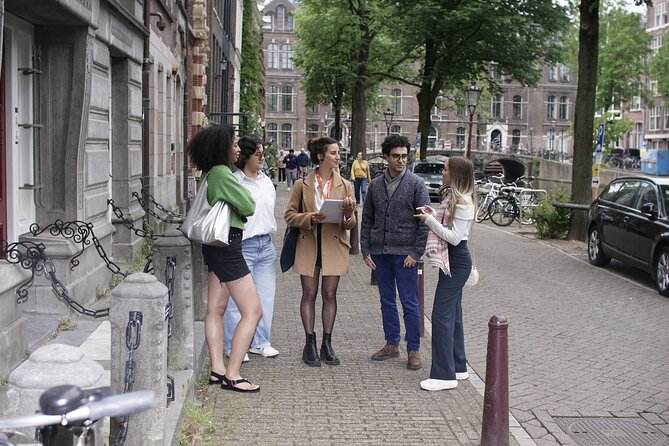
Empire shows up in plain sight. This walking tour connects Amsterdam’s colonial trading power to real streets and buildings, stop by stop. I like the 2-hour pace that keeps you moving without feeling rushed, and I also like that the guide uses visuals to make the story easier to picture. One thing to consider: you are on foot for about two hours and you’ll want a moderate fitness level.
You start at Nieuwmarkt 4, in front of Restaurant-Café In de Waag. Look for your guide with an orange umbrella for quick recognition, and plan to end near Dam Square by the National Monument. With a small group size (up to 15) and a mobile ticket, it’s an easy add-on day activity, especially if you booked ahead, since this one is often reserved about 78 days in advance.
In This Review
- Key highlights you should care about
- Why this 2-hour Amsterdam walk works so well
- Nieuwmarkt to Oostindisch Huis, where East India trade took shape
- Binnengasthuisstraat and Stadsarchief Amsterdam, the corporate engine behind the story
- Herengracht and De Gouden Bocht, wealth and power in plain view
- Singel and Multatuli, resistance against slavery and the question of remembrance
- Royal Palace Amsterdam and Dam Square, institutions and national memory
- The guide experience: you get clarity, and you can see it
- Value for money: what $39.32 buys you in real life
- How to get the most out of each stop (without overthinking it)
- Who should book this tour
- Should you book Amsterdam’s Colonial Past – The Untold Story walking tour?
- FAQ
- How long is the Walking Tour Amsterdam’s Colonial Past – The Untold Story?
- How much does the tour cost?
- Is the tour offered in English?
- Where does the tour start and end?
- Do I need to print anything, or is it mobile?
- How big is the group?
- Are admission tickets included at the stops?
- Is tips and gratuities included in the price?
Key highlights you should care about
- Orange umbrella start makes it simple to find your guide at Nieuwmarkt
- Small group size (max 15) keeps the walking tour feel personal and interactive
- Free admission tickets at stops means less hassle and fewer cost surprises during the walk
- Trade plus memory, from canal-side wealth to slavery resistance and abolition themes
- English guide support, with at least one guide (Giovanni) using images to add context
Why this 2-hour Amsterdam walk works so well
Amsterdam can feel like a postcard city, all canals and clever architecture. This tour takes that familiar scene and adds the missing layer: how colonial trade, money, and institutions shaped the Netherlands and how the city has marked that story. The best part is the format. In about 2 hours, you move through 10 stops, each one short, so the tour stays focused instead of turning into a long lecture.
I also like how the route is practical. It connects places you can recognize on your own later: Nieuwmarkt, canal streets like Herengracht, and major landmarks like Dam Square. You are not just learning names, you are learning where to look. That helps you understand why the city still talks about commerce, power, and remembrance right out in the open.
The price, $39.32 per person, lands in the middle for a guided walking tour, but the value improves because the schedule includes free admission tickets at each stop. You still pay for interpretation and guidance, but you avoid that extra “pay at the door” feeling during the route. Tips are not included, so budget for that if you want to reward your guide.
More of the canal ring crossed on foot:
- Amsterdam Anne Frank: Small-Group Walking Tour & Local Guide
★ 4.8 · 12,789 reviews - Anne Frank’s Story – Guided Walking Tour through Amsterdam
★ 5.0 · 11,619 reviews - Absolutely Amsterdam – the Essential Introductory Walking Tour
★ 5.0 · 3,629 reviews
Nieuwmarkt to Oostindisch Huis, where East India trade took shape
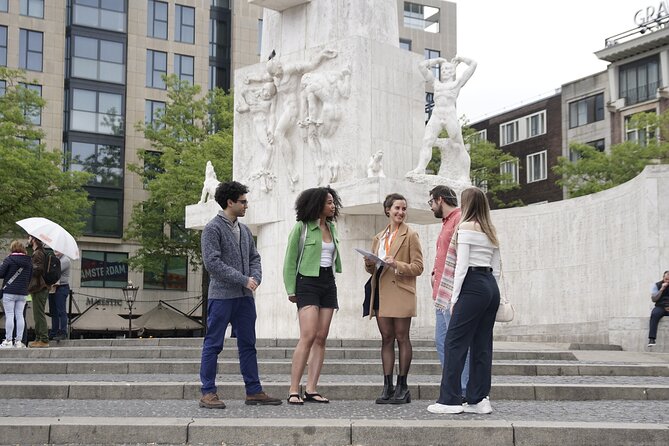
The tour begins at Nieuwmarkt 4, in front of Restaurant-Café In de Waag. Your guide holds an orange umbrella, which sounds small, but it matters. It means you spend less time searching and more time listening, especially if you arrive a few minutes late.
Stop 1: Nieuwmarkt is your orientation point. The tour theme is not abstract. From the first minutes, you’re pointed toward how the city’s role in colonial trade connects to the street pattern around you. Even if you are not a history buff, the guide’s job is to translate the past into what you can see right now.
Then you head to Oostindisch Huis for a stop on the rise of the East India trade. This part works because it frames colonialism as an economic system, not just a moral story told in hindsight. You start to understand that ships, trading networks, and financial incentives created the pressure that later shaped laws, companies, and public messaging. You also get a sense of how Amsterdam’s identity as a port city fed into colonial expansion.
A practical drawback here is pacing. Each stop is about 15 minutes, sometimes less later. If you love stopping for photos or want extra time to read plaques, bring patience and keep your picture-taking quick. The tour is built for motion.
Binnengasthuisstraat and Stadsarchief Amsterdam, the corporate engine behind the story
Next up is Binnengasthuisstraat, focused on the foundation of the West India Company. I like this placement because it links East India and West India trade without forcing you to follow a dense timeline. You are seeing how different colonial directions fed into a similar idea: companies with power, resources, and reach.
After that you reach Stadsarchief Amsterdam. This stop centers on the NHM, described as a Dutch trading and financial company established in 1824 in The Hague by King William I to support and develop trade, shipping, and agriculture. That detail matters, because it pulls colonial commerce out of the 1600s vibe and shows it continued in organized, state-linked ways.
What makes this stop especially useful is how it gives you a concrete example. Instead of only hearing broad claims, you get a named institution, a founding year, and a purpose tied to shipping and trade. That’s the kind of information that actually helps you keep the story straight later while you wander on your own.
Herengracht and De Gouden Bocht, wealth and power in plain view
The tour shifts from company and finance to the city’s visual language of success.
At Herengracht, you focus on a mayor’s residence and a commemorative plaque in front of the house. This is where the “untold story” idea becomes real. You’re not just looking at history as something behind glass. You’re seeing how public memory can be attached to prestigious addresses and official figures.
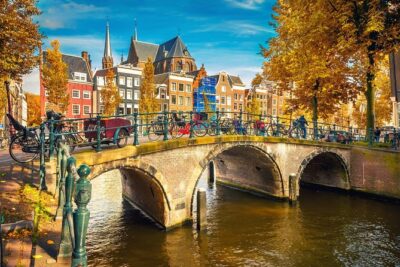
Then you move to De Gouden Bocht, Amsterdam’s Golden Bend, described as the most prestigious and chic canal section. Even if you know Amsterdam canals already, this stop gives you a new lens. You start asking different questions while you look at the elegant curve of water and buildings. Who paid for it? Who benefited? How does a city display status while also carrying the consequences of that status?
The potential downside here is that the tour is still short. You might want more time to absorb the canal views, but the real goal is to connect those views to the moral and economic story the tour is building.
A different use for the same hours in Amsterdam:



Singel and Multatuli, resistance against slavery and the question of remembrance
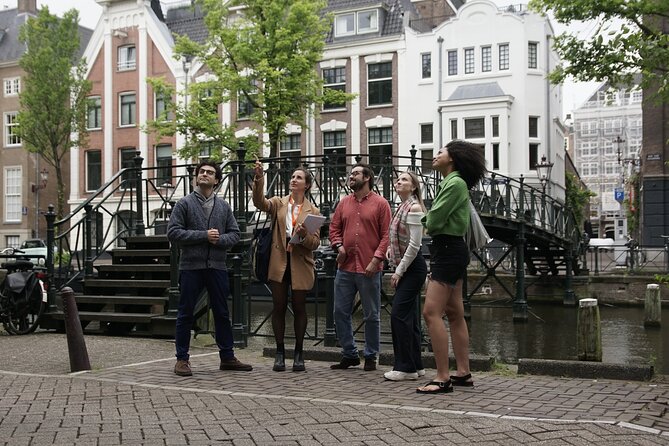
One of the strongest parts of this tour is how it refuses to end with trade and companies. You get to Singel, where the stop is about resistance against slavery. This is the moment where the story shifts from power structures to human pushback, and that change keeps the tour from becoming one-note.
After Singel, you visit the Statue of Multatuli. The stop theme is abolition of slavery in Indonesia. Multatuli is not just treated as a statue in a public square. The tour uses the monument to anchor the idea of abolition and how it is remembered in Amsterdam.
I especially appreciate this arc because it helps you avoid a common trap. Colonial history can become a list of institutions and dates. Here you are guided toward what happened on the ground and what societies chose to do, or fight for, in the aftermath.
If you want photos, this is a good place to take them quickly without missing what the guide is explaining. The tour timings stay tight, around 10 to 15 minutes per stop in this area too.
Royal Palace Amsterdam and Dam Square, institutions and national memory
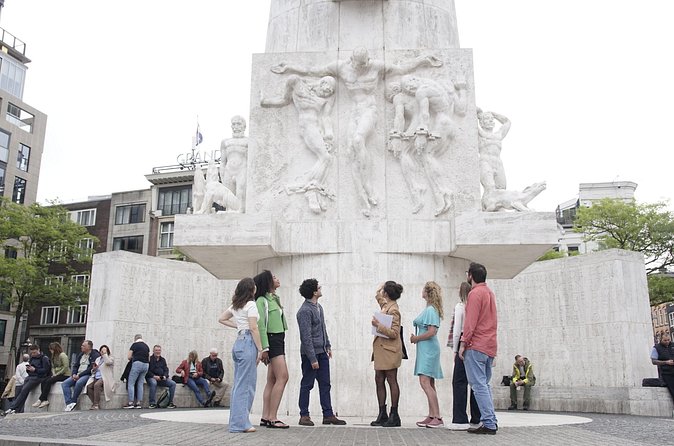
The tour continues with two big landmarks that make the theme feel official and national.
At Royal Palace Amsterdam, the focus is on the role of the Royals during colonialism. This matters because it challenges the idea that royal symbolism is only decorative. You are given a prompt to connect monarchy with the broader system of colonial power.
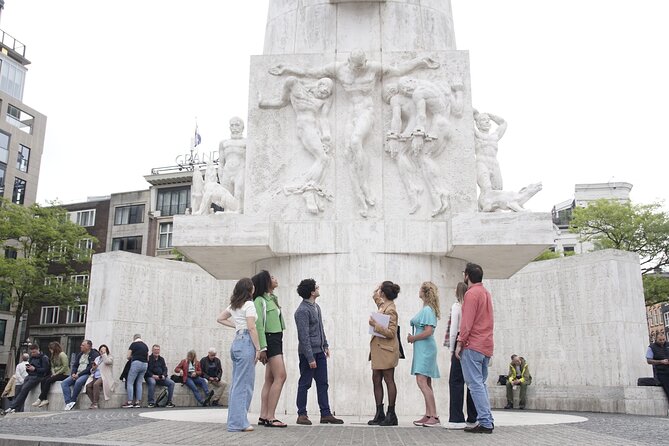
Then you finish at Dam Square, with time set aside for the National War Memorial. Ending here works for two reasons. First, Dam Square is a central point you likely pass anyway. Second, memorial spaces force you to think about public narratives. The tour doesn’t just point at colonial money. It also nudges you to ask how a country remembers conflict and wrongdoing in national spaces.
This is also where you might feel the end-of-tour energy. The last stop is about 15 minutes, and the route ends at Dam Square near the National Monument. Plan to keep your phone charged, because you’ll likely want to look up extra context while you walk away.
The guide experience: you get clarity, and you can see it
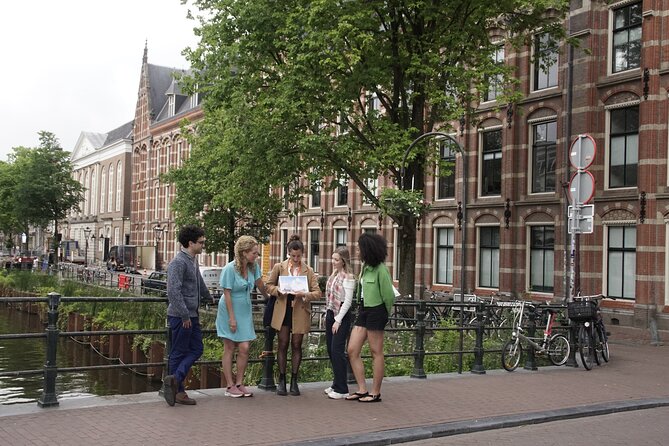
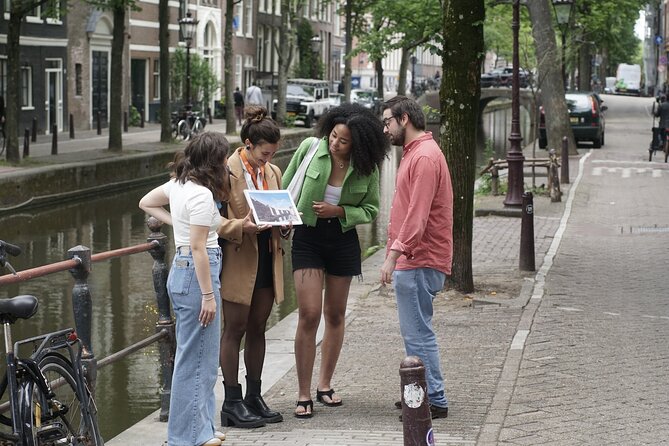
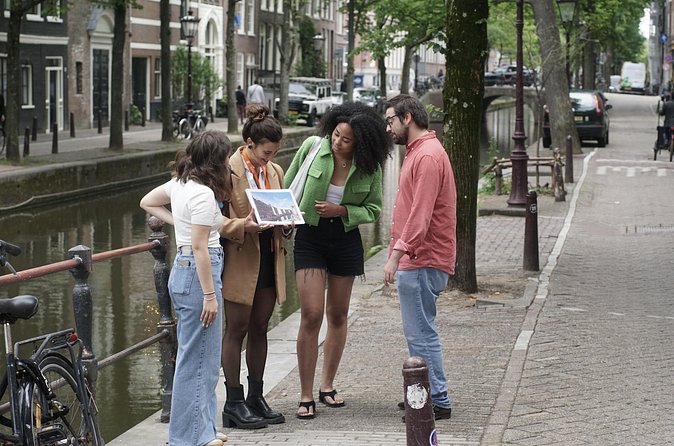
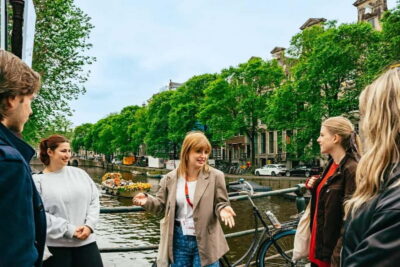
The tour is built for comprehension, not just facts. One review specifically highlighted that the guide Giovanni was super informative and kind, and that he brought images to help with historical context. That detail is more important than it sounds.
Images help you hold the story in your head. Colonial trade can feel abstract until you can connect it to documents, maps, or visual cues. When a guide uses images, it also helps if you are not the type who loves reading plaques. Even short explanations land better when you can visualize the reference point.
Since the tour language is English, this is a good pick if you want historical context but don’t want to rely on your own interpretation of every sign and monument. The guide is there to connect the dots at a walking pace.
Value for money: what $39.32 buys you in real life
Let’s talk value like a practical shopper.
You pay $39.32 per person for a live, English-speaking guide and about 2 hours of guided interpretation across 10 themed stops. The itinerary also includes free admission tickets at the locations on the schedule, which reduces extra costs during the experience. For a city like Amsterdam where you might pay for attractions, that matters.
You also get a small group limit of 15 travelers, which usually means less waiting and more back-and-forth at the pace of the walk. And because it’s a mobile ticket tour, it’s simple to manage day-of.
One cost consideration: tips and gratuities are not included. If you usually tip for guided tours, budget for that. If you don’t, you’ll still get the core experience, but you might want to reflect on whether your guide’s effort seems worth extra support.
How to get the most out of each stop (without overthinking it)
You’ll get more from this tour if you come with a simple game plan:
- Wear comfortable shoes. It’s a walking tour for about two hours, and the itinerary assumes you can keep moving between stops.
- Bring your curiosity. The stops are short, so listen for what connects one location to the next.
- If you like photos, do quick shots first, then pay attention. The story matters more than a perfect canal angle here.
- Look for the orange umbrella at the start so you don’t waste the first minutes.
And here’s a subtle tip. As you walk, try switching mental gears between “beauty” and “mechanism.” Canal-side wealth and official buildings can look timeless. The guide pushes you to see the economic machine behind that appearance.
Who should book this tour
This is a solid fit if you:
- Want a focused, guided way to understand Amsterdam’s colonial connections in a short time
- Prefer walking routes tied to specific landmarks instead of museum-only learning
- Like a guide who uses visual context, as at least one guide, Giovanni, has done
It may be less ideal if you:
- Want a long, slow pace with extended time inside major sites
- Plan to skip listening because you’re mainly in photo mode
- Have very limited mobility, since you should have a moderate physical fitness level
Should you book Amsterdam’s Colonial Past – The Untold Story walking tour?
If you want the short version of Amsterdam that includes the parts people often gloss over, I think this tour is worth your time. The route is concentrated, the themes connect economics to public memory, and the English live guide helps you make sense of what you see around Nieuwmarkt and end around Dam Square.
Book it if you like a guide-led explanation that stays practical and story-driven. I’d also book it sooner rather than later, since it’s often reserved about 78 days in advance. And if you care about being able to visualize context, this is the kind of tour where a guide bringing images can really help.
FAQ
How long is the Walking Tour Amsterdam’s Colonial Past – The Untold Story?
It’s approximately 2 hours.
How much does the tour cost?
The price is $39.32 per person.
Is the tour offered in English?
Yes, it’s offered in English.
Where does the tour start and end?
It starts at Nieuwmarkt 4, 1012 CR Amsterdam and ends at Dam Square (National Monument), 1012 JS Amsterdam.
Do I need to print anything, or is it mobile?
You get a mobile ticket.
How big is the group?
The tour has a maximum of 15 travelers.
Are admission tickets included at the stops?
The itinerary indicates admission ticket free at the stops.
Is tips and gratuities included in the price?
No, tips and gratuities are not included.
Newest on the canal ring
- Amsterdam Bike Food Tour with Private Guide★ 5.0 · 1 review
- Amsterdam: Rijksmuseum Private Tour with an Art Historian★ 5.0 · 1 review
- Happy B-day Amsterdam! Guided Tour with a History Buff★ 5.0 · 1 review
- Local Foodie Adventure in Amsterdam★ 5.0 · 1 review
- Private Photo Shoot in Amsterdam with a Professional Photographer★ 5.0 · 1 review
- Private day trip to Giethoorn and the Enclosing Dike★ 5.0 · 1 review
- Private Sightseeing Tour to Giethoorn from Amsterdam incl. canal cruise★ 5.0 · 1 review
City Walking Tours, compared.

Amsterdam Anne Frank: Small-Group Walking Tour & Local Guide
Read our review →
Anne Frank’s Story – Guided Walking Tour through Amsterdam
Read our review →
Absolutely Amsterdam – the Essential Introductory Walking Tour
Read our review →
Anne Frank Guided Walking Tour in DE/EN/IT/ES
Read our review →

Anne Frank Walking Tour Amsterdam Including Jewish Cultural Quarter
Read our review →Browse the lists this tour appears in