
Reviewed · ANNE FRANK HOUSE TICKETS
Anne Frank story, Jewish District Amsterdam, WW2
These streets hold more than stories. This Amsterdam Jewish District walk connects the places tied to the Holocaust, with a guide who answers your questions as you go. I especially liked the small-group pace, and I also liked how the route threads through real neighborhood corners like Kattengat and Spuistraat instead of feeling like a drive-by. The one thing to watch for is that this tour is short, so you will not get Anne Frank House time, and it may feel brisk if you want lots of museum-style stops.
For planning, think of it as a focused, guided “see and understand” route. The tour runs about 2 hours 10 minutes in English, capped at 15 people, and it ends at the Portuguese Synagogue area. If you come wanting deep museum hours, you may feel you have time only for the street-level sites and the key memorials.
In This Review
- Key things you’ll notice on this Amsterdam Jewish District walk
- A 2-hour walk that turns the map into meaning
- Price and practicalities for your day in Amsterdam
- Starting at De Sluyswacht and ending near the Portuguese Synagogue
- Portuguese Synagogue (1675): the Sephardic chapter that sets context
- 102,000 Names monument: why the numbers matter
- Kattengat and Spuistraat segments: the neighborhood lens
- From arrest to transport: the place where people were taken
- “Best place to Hide in WW2”: turning fear into a clear picture
- Canal-side deportation memorials and the Docksworker monument
- Polish concentration camp memorial: keeping the victims in the focus
- What the guide does (and why it matters more than you think)
- How long is enough, and who this tour suits best
- Should you book this Amsterdam Jewish District tour?
- FAQ
- How long is the tour?
- What is the price per person?
- Is the tour offered in English?
- How big is the group?
- Where do I meet the guide?
- Where does the tour end?
- What is included in the ticket price?
- Are food or beverages included?
- Are Anne Frank museum tickets included?
- What is the cancellation policy?
Key things you’ll notice on this Amsterdam Jewish District walk
- Portuguese Synagogue background (1675) and the Sephardic Jewish story tied to Spain and Portugal
- 102,000 Names monument and what it makes you slow down to read
- The transport-gathering point where arrests led to deportation
- A WW2 hiding-place story that turns abstract history into something you can picture
- Canal-side deportation memorials, including a monument tied to people taken from their homes
- A Polish concentration camp memorial, keeping the victims part of the route’s purpose
A 2-hour walk that turns the map into meaning
Amsterdam can be confusing in the best way. Streets braid together, canals cut through, and it is easy to feel like you are just collecting pretty views. This tour does the opposite. It takes you through the Jewish District with a clear wartime lens, so the route feels like a timeline you can walk.
You will start on Jodenbreestraat at De Sluyswacht area, then move through the neighborhood with stops that bring you from synagogues and communal life to arrest, transport, hiding, and memorials. Even when you are just passing landmarks, your guide is doing something practical: answering what you wonder about, and pointing out why a specific location mattered. That Q&A element matters more than people expect, because it stops the story from turning into a list.
One more point I like for value: the tour stays compact. At about 2 hours 10 minutes, you get a strong overview without eating your entire day. At the same time, the short duration is also the trade-off. You will not have the time or included tickets for museum-level add-ons like Anne Frank House.
Other walks through Jewish Amsterdam:
- Anne Frank Walking Tour Amsterdam Including Jewish Cultural Quarter
★ 5.0 · 1,879 reviews - Anne Frank and Jewish Quarter Amsterdam Private Walking Tour
★ 5.0 · 684 reviews - Amsterdam: Anne Frank and Jewish Quarter Tour
★ 4.7 · 434 reviews
Price and practicalities for your day in Amsterdam

The price is $90.70 per person for an in-person guide, and the tour runs roughly 2 hours 10 minutes. For Amsterdam, that is not a cheap afternoon, but it is also not inflated for a group tour that takes you through multiple memorial sites and historical locations with a live guide.
What makes that cost feel more reasonable is what is included: guidance in English, an in-person leader, and a route designed around key stops rather than wandering. You also get a mobile ticket, and the group size is kept small, up to 15 travelers, which usually means more chances to ask questions without shouting over a crowd.
Practical notes you should plan around:
- The pace assumes moderate physical fitness, so wear comfortable walking shoes.
- You will be near public transportation, so it is easy to connect to the rest of your day.
- Service animals are allowed.
Also, note what is not included: food and beverages, and Anne Frank museum tickets. If you want Anne Frank House entry, you should plan it separately.
Starting at De Sluyswacht and ending near the Portuguese Synagogue
Your meeting point is De Sluyswacht, Jodenbreestraat 1. That area is a good place to start because it is already in the thick of the Jewish District. It helps you get oriented right away, instead of spending your first 20 minutes just trying to find the right street.
The tour ends at the Portuguese Synagogue of Amsterdam, Mr. Visserplein 3, in the same neighborhood. The route also references the Docksworker monument near the endpoint area, so you will likely finish in a spot where the memorial purpose is still in your head.
If you like finishing your day with food or another museum, you are in a handy zone. Just keep in mind that the tour does not include any time buffers for Anne Frank House.
Portuguese Synagogue (1675): the Sephardic chapter that sets context
One of the first stops is the Portuguese Synagogue of Amsterdam, built in 1675. The key detail your guide will focus on is that it was founded by Sephardic Jews, people whose roots trace back to Spain and Portugal.
Why I think this stop is important in a WW2 themed tour is simple: it reminds you this story did not begin in 1940. Jewish life in Amsterdam had deep local roots, with distinct communities and cultural identities. When you understand that, the later violence hits harder, because you are not just seeing a single dark period. You are seeing what was being taken away.
If you are the type who reads plaques slowly, this is a good moment to pause. The synagogue connection also gives you a baseline for the rest of the walk, since the route moves from communal places into the machinery of persecution.
Other routes to the Anne Frank House:
102,000 Names monument: why the numbers matter
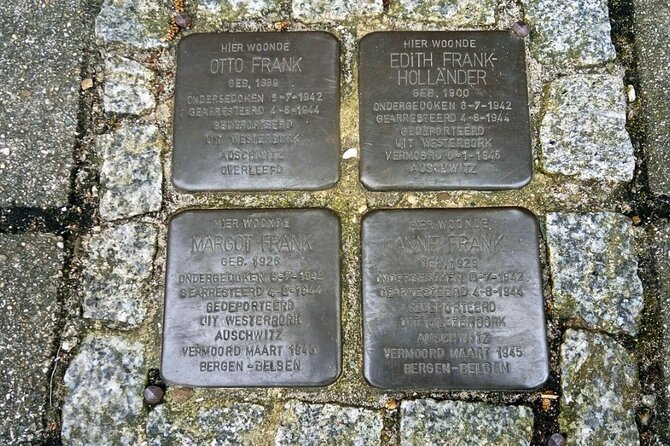
Another stop is the monument listing 102,000 Names of Dutch Jews, Roma, and Sinti victims of the Holocaust. This is one of those locations where your brain wants to skim, because it is too much information at once.
I like that the tour makes you confront it at walking pace, not from a bus window. A guide can also help you handle the emotional weight without turning it into a lecture. The practical takeaway is that you learn what the monument represents, not just that it is there.
Here is what you should do in your own head while you are looking at it: treat it like a list of people, not a statistic. Even if you do not read every name, you will feel the weight more when you realize the monument is specifically about Dutch Jews plus Roma and Sinti victims, not just one group.
Kattengat and Spuistraat segments: the neighborhood lens

You also go through areas like Kattengat and Spuistraat, plus the Dam Square area. These are not just “transfer streets.” They help you understand how close daily life was to the sites connected to raids and deportations.
This matters if you think you already know the story. Amsterdam did not operate as a distant stage. People lived nearby. People worked nearby. Streets you might otherwise treat as shopping routes were part of the same urban world.
If you are prone to checking your phone while walking, this tour is a good reminder to put it away for stretches. When you slow down through normal streets, you start to connect what you see now to what residents faced then.
From arrest to transport: the place where people were taken
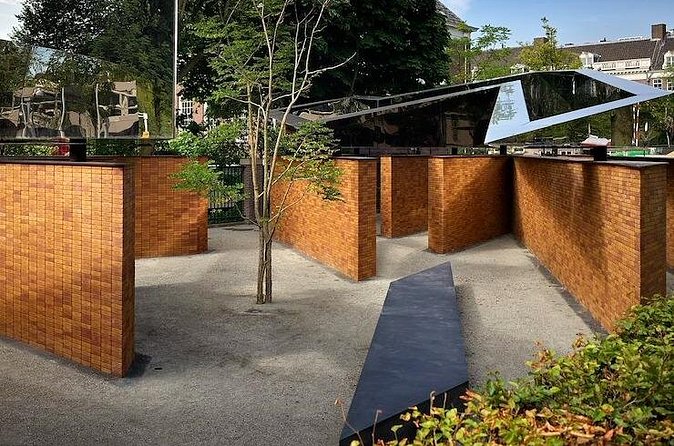
At one stop, you will learn about the place where Jews were brought for transport after being arrested or taken from their homes. The point here is not only tragedy, it is also process.
When history includes steps, it becomes easier to understand how something horrifying became systematic. A guided walk helps you place that process in a real setting, instead of keeping it as a distant idea. You will likely hear how people were gathered and moved, and why that particular type of location became part of the deportation chain.
What I appreciate is that this part of the tour is not vague. The tour describes the function of the spot, which gives your mind something concrete to hold. For a lot of people, that is what turns a memorial tour into understanding.
“Best place to Hide in WW2”: turning fear into a clear picture
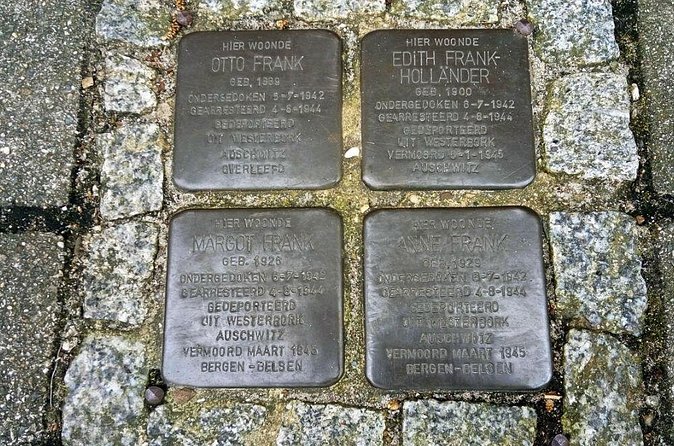
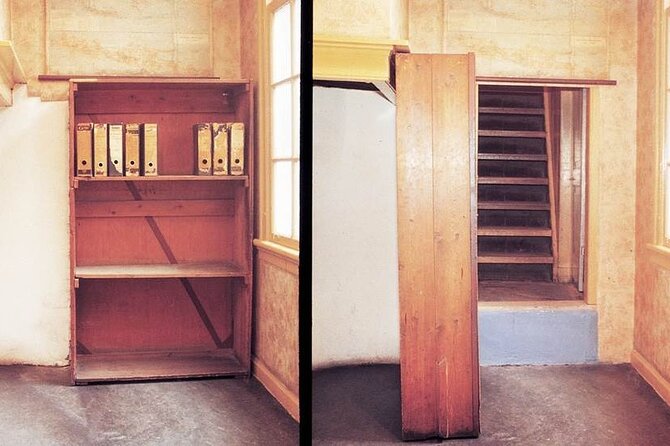
Another stop is described as the best place to hide in WW2. That wording signals the tour’s focus on survival and risk, not only on arrests and memorials.
Even without extra details in the stop description, this moment is usually where the story shifts gears. You start thinking about what it would mean to stay quiet, remain unseen, and make tiny choices under impossible stress. A guide can also help connect this to the broader wartime picture of Amsterdam’s Jewish community.
My advice: do not treat this as a dramatic story beat. Treat it like a thought experiment you do with respect. Ask yourself what hiding would require, and then listen to how the guide frames why people attempted it.
Canal-side deportation memorials and the Docksworker monument
The route also includes a stop described as a monument of people taken from their homes on the other side of the canal. This is the kind of detail that makes walking tours different from museum tours. The canal is still here. The separation is still built into the geography.
You feel the physical idea of “other side” when you stand there. The monument then stops being symbolic and starts being spatial, which is what history sometimes needs to stick.
Your endpoint area references the Docksworker monument as well. That makes sense in a WW2 context, because docks, workers, and the movement of people were part of how the city’s systems could be used for cruelty. Finishing near such a monument helps you end with the theme still active in your head.
Polish concentration camp memorial: keeping the victims in the focus
The tour also stops at a monument for people killed at a Polish concentration camp. The stop is intentionally specific in its purpose, even if the camp name is not repeated in the summary you provided.
This part of the walk matters because it bridges Amsterdam and what happened afterward. It is easy to get stuck imagining what happened locally in the Netherlands, but deportation led to killings far beyond the city. A guide can help you make that mental connection without letting it turn into random, disconnected suffering.
I find these memorial stops work best when you treat them as a pause for respect, not a photo op. It is okay to take one picture if you want to remember the location, but the value is in understanding what the monument is honoring.
What the guide does (and why it matters more than you think)
Your guide is part of the core value. The tour is offered in English, and the description emphasizes that the guide provides insight, answering questions and adjusting to your pace and interests.
That is not a minor perk. In a tour dealing with complicated topics, the ability to ask one question and get a useful answer can save you from confusion. It also helps you connect dots without feeling like you are stuck reading on your own.
The small group size, maximum 15 travelers, also helps. You are less likely to feel herded, and you can stop when you need an extra minute to process what you just learned. One practical reason I like small groups in memorial settings is that you can hear the guide without the usual group chaos.
How long is enough, and who this tour suits best
At about 2 hours 10 minutes, this is a “key sites” tour, not an all-day deep dive into every related museum. That makes it a good fit for:
- First-time visitors who want a focused Jewish District and WW2 orientation
- People who prefer walking with context instead of long indoor sessions
- Anyone who wants an answerable, Q&A friendly format with a small group
It might not be ideal if:
- You are hoping to also do Anne Frank House during the same experience, because museum tickets are not included
- You want long, slow reading time at multiple museums
- You dislike tight schedules and prefer half-day or longer tours
A related note based on how the experience is currently structured: the duration has been adjusted to be shorter than earlier longer versions. That should help if you were worried about sitting through too much time without enough new stops.
Should you book this Amsterdam Jewish District tour?
Book it if you want a short, guided route that connects the Anne Frank era theme to the Jewish neighborhood’s WW2 reality through real places and memorials. I think the biggest selling points are the small-group experience and the fact that your guide answers questions while you walk, so you do not leave with only names and dates.
Skip it or plan extra time elsewhere if you are chasing Anne Frank House entry or museum-style browsing, because those pieces are not included here. Also be honest with yourself about your tolerance for emotional heaviness. This is a memorial-focused walk, and it should be treated that way.
If you do book it, come with good walking shoes, set aside phone distraction, and be ready to pause. The route works best when you let the streets do their job.
FAQ
How long is the tour?
It runs about 2 hours 10 minutes.
What is the price per person?
The price is $90.70 per person.
Is the tour offered in English?
Yes, it is offered in English.
How big is the group?
The tour has a maximum of 15 travelers.
Where do I meet the guide?
The start is De Sluyswacht, Jodenbreestraat 1, 1011 NG Amsterdam.
Where does the tour end?
It ends at the Portuguese Synagogue of Amsterdam, Mr. Visserplein 3, 1011 RD Amsterdam.
What is included in the ticket price?
An in-person guide is included.
Are food or beverages included?
No, food and beverages are not included.
Are Anne Frank museum tickets included?
No, Anne Frank museum tickets are not included.
What is the cancellation policy?
You can cancel for a full refund up to 24 hours before the experience starts. If you cancel less than 24 hours in advance, the amount paid is not refunded.
Newest on the canal ring
- Amsterdam Bike Food Tour with Private Guide★ 5.0 · 1 review
- Amsterdam: Rijksmuseum Private Tour with an Art Historian★ 5.0 · 1 review
- Happy B-day Amsterdam! Guided Tour with a History Buff★ 5.0 · 1 review
- Local Foodie Adventure in Amsterdam★ 5.0 · 1 review
- Private Photo Shoot in Amsterdam with a Professional Photographer★ 5.0 · 1 review
- Private day trip to Giethoorn and the Enclosing Dike★ 5.0 · 1 review
- Private Sightseeing Tour to Giethoorn from Amsterdam incl. canal cruise★ 5.0 · 1 review
Anne Frank House Tickets, compared.

Amsterdam Anne Frank: Small-Group Walking Tour & Local Guide
Read our review →
Anne Frank’s Story – Guided Walking Tour through Amsterdam
Read our review →
Anne Frank Guided Walking Tour in DE/EN/IT/ES
Read our review →
Anne Frank Walking Tour Amsterdam Including Jewish Cultural Quarter
Read our review →
Anne Frank’s Last Walk & See Anne Frank House in Virtual Reality
Read our review →
Anne Frank and Jewish Quarter Amsterdam Private Walking Tour
Read our review →
Anne Frank’s Last Walk & Visit Anne’s House in VR
Read our review →Browse the lists this tour appears in