
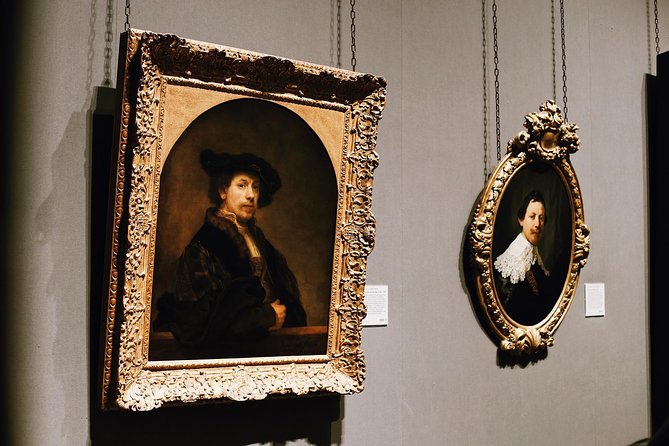
Reviewed · RIJKSMUSEUM TICKETS
Skip-the-line Rijksmuseum & Rembrandt House & City – Exclusive Tour Guided Tour
Rijksmuseum and Rembrandt, without the museum maze. You get skip-the-line entry to the Rijksmuseum, then a guided look at just enough Dutch art, artifacts, and context to make the place click. What I like most is the mix of famous masterpieces and the smart, slightly surprising details a self-guided visit often misses, from dollhouses and Delft ceramics to Vermeer’s The Milkmaid. The day also includes Rembrandt’s own home at the end, so you’re not only seeing his work, you’re getting the setting where he lived and worked.
I also like that the tour doesn’t stop at art. Between the two museums, you walk through historic Amsterdam, with canal stops and city landmarks that help you connect what you saw inside with what shaped the city outside. One possible drawback is the pace: it’s about 5.5 hours and you’ll do a fair amount of standing and walking, plus there are security rules (and some quiet rooms where speaking is restricted).
In This Review
- Key points before you go
- How the half-day tour really feels in Amsterdam
- Rijksmuseum entry: the art hits faster when someone maps your time
- What you’ll focus on inside
- A practical way to think about the Rijksmuseum
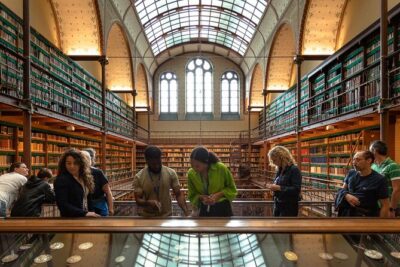
- The 19th-century library and why it’s more than a room of books
- The canal walk that turns landmarks into context
- Spiegelkwartier and Singelgracht
- Keizersgracht, the Emperor’s Canal
- Museum Van Loon stop, from the outside
- Bloemenmarkt, Munttoren, and Rembrandtplein
- Bloemenmarkt and the Munttoren
- Rembrandtplein and The Night Watch bronze cast
- The Amstel, two bridges, and the city’s layers
- Stopera: city hall meets opera and ballet
- Jodenbuurt and the Rembrandt House finish
- Museum Het Rembrandthuis: where Rembrandt lived and worked
- What’s included, what you pay for, and why the price makes sense
- Weather, closures, and museum rules you should not ignore
- Who this tour suits best
- Should you book this Rijksmuseum and Rembrandt House tour?
Key points before you go
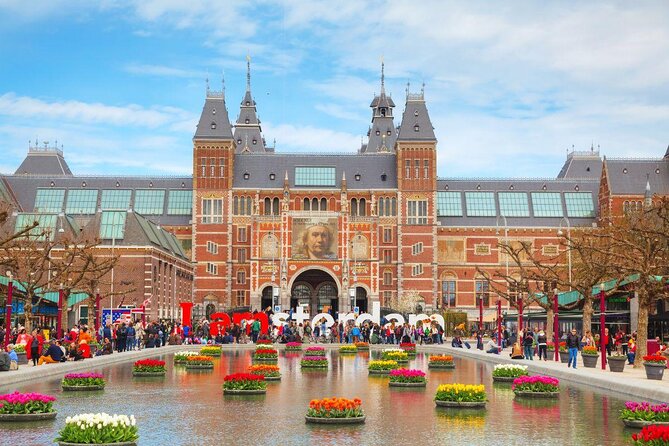
- Skip-the-line access at both major stops saves time where it matters most.
- 8000 objects at the Rijksmuseum gets turned into a clear route, not a hit-and-miss wandering day.
- Rembrandt House Museum adds context by showing where Rembrandt lived and worked (1639 to 1656).
- The walk includes named canal areas like Singelgracht and Keizersgracht, plus views near Rembrandtplein and the Amstel.
- The tour runs rain or shine, so plan for weather and keep layers handy.
How the half-day tour really feels in Amsterdam
This is a half-day plan built for your attention span. It starts at Cobra Café, Hobbemastraat 18, at 10:00 am, and finishes at Rembrandt House Museum, Jodenbreestraat 4. The total time is about 5 hours 30 minutes, and that includes a lunch break.
You are on a private tour, meaning it’s only your group. That matters because a good guide can adjust on the spot. If your group is more into paintings, they steer you that way. If you’re more curious about everyday objects and Dutch life, they can shift focus. For a museum this size, having someone set the route is the difference between feeling oriented and feeling lost.
One more thing I’d flag early: even with skip-the-line style access, security and crowd flow can still create queues at some points. It’s not a guarantee that you will never wait, but it usually keeps you from wasting the best hours of the day.
Other Rembrandt trails through Amsterdam:
- Amsterdam: Van Gogh & Rembrandt Captivating Experience Entry
★ 4.3 · 615 reviews - Rembrandts Experience Amsterdam Admission Ticket
★ 4.5 · 521 reviews - Rembrandt House Museum Amsterdam Entrance Ticket
★ 4.5 · 355 reviews
Rijksmuseum entry: the art hits faster when someone maps your time
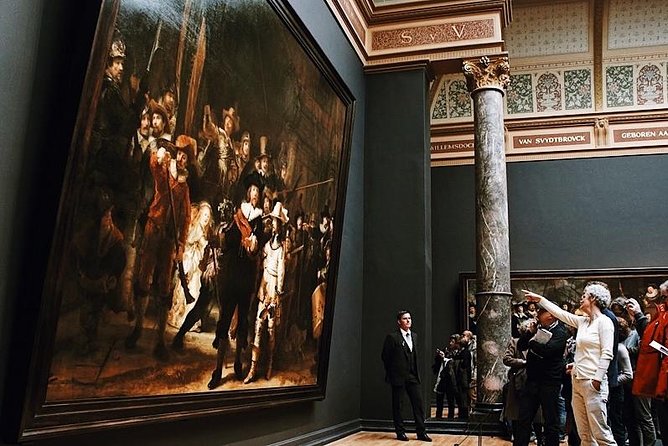
The tour’s first big stop is the Rijksmuseum, often described as Holland’s version of the Louvre because of its scale and collection depth. The museum is enormous, and it’s filled with around 8000 objects on display. Going solo can turn into a blur of rooms and labels. With a guide, you get a route that builds understanding as you move.
What you’ll focus on inside
The best part is that you don’t just get the “must-see” paintings. You also get the supporting cast of Dutch culture: the objects and themes that make the art make sense.
Expect to spend time on highlights such as:
- Rembrandt masterworks including The Night Watch
- The Jewish Bride
- The Syndics of the Drapers’ Guild
- Vermeer’s The Milkmaid
- The 19th-century library
- 17th-century dollhouses, plus globes, a ship replica, and Delft ceramics
The tour also pays attention to what changes your perspective. For example, you’re not only hearing about famous names like Rembrandt. You’re also seeing why small domestic objects and model worlds mattered to people in the 1600s. Those dollhouses and decorative items help you picture what wealth, craft, and everyday life looked like back then.
A practical way to think about the Rijksmuseum
Here’s the simple rule: you do not need to see everything. You need to see enough that your brain can organize the rest later. A guided route helps you get that “mental shelf” feeling fast.
Also watch for comfort and rules. The tour notes that dress is required for entry into some sites, and inside the museum there are restrictions: no large bags are allowed, and you’ll need to stick to handbags or small thin bag packs through security. If you travel with a backpack or bigger bag, plan for extra time at security and keep your essentials easy to grab.
More ways into the Rijksmuseum:
The 19th-century library and why it’s more than a room of books
One of the standout elements here is the 19th-century library. It’s not included just as a decorative moment. It’s a clue to how the museum connects knowledge, objects, and education.
If you normally breeze past libraries in museums, this is worth slowing down for. You’ll get the sense that the Rijksmuseum isn’t only a place to look at paintings. It’s a place that frames Dutch life through artifacts, learning, and collections. When that clicks, the rest of the visit feels more coherent.
This is also where a guide helps you read the room. If a space has quiet or restricted speaking rules, your guide will explain what’s expected before you enter. That little heads-up keeps the experience smooth and avoids awkward “wait, are we allowed to talk?” moments.
The canal walk that turns landmarks into context
After the museum time, the tour shifts from galleries to street-level Amsterdam. This part is a big part of the value because it connects art and city design. You’ll head toward the inner-center canal system and make a few quick stops along the way.
Spiegelkwartier and Singelgracht
You’ll walk toward Spiegelkwartier and see the Singelgracht canal, which borders the center of Amsterdam. This canal used to form part of the city’s outer defenses, which gives you a different way to read the water. It’s not just scenery, it’s history in plain view.
This section is mostly about getting your bearings. If you like walking while still learning, you’ll appreciate it here because it’s short enough to stay energetic.
Keizersgracht, the Emperor’s Canal
Next you’ll see the Emperor’s Canal (Keizersgracht). It’s named after Maximillian of Austria and it’s the widest of the three major inner-city canals. That width matters when you’re standing on a bridge looking along the canal. You can actually feel how the city’s waterways relate to movement and space.
Museum Van Loon stop, from the outside
You’ll also pass by Museum Van Loon, a canalside house. It’s known for being associated with Ferdinand Bol, Rembrandt’s favorite pupil. The tour notes that admission isn’t included for this stop, so you’re likely seeing the building and its setting rather than doing a full interior visit.
If you love architecture or the look of historic canal houses, this is a nice “pause” moment without adding extra tickets.
Bloemenmarkt, Munttoren, and Rembrandtplein
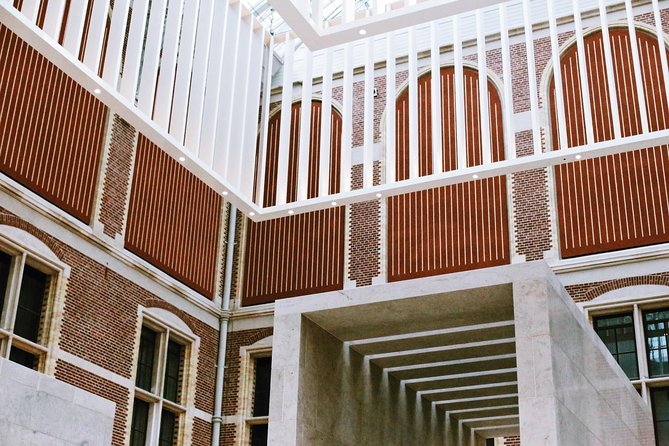
The walking continues through some of Amsterdam’s most recognizable spots, and the guide keeps the stops tied to stories.
Bloemenmarkt and the Munttoren
You’ll go through the flower market at Bloemenmarkt and spot the Munttoren, often nicknamed the Mind Tower. The key detail is that it originally belonged to a main gate in Amsterdam’s medieval city wall. So even in a place that feels modern and commercial, you’re still looking at a remnant of earlier defensive planning.
Rembrandtplein and The Night Watch bronze cast
Then you’ll reach Rembrandtplein, one of the busiest squares named after Rembrandt. Here you’ll see a bronze-cast representation of The Night Watch, originally displayed for the artist’s 400th birthday celebration in 2006.
It’s a smart stop because it bridges the museum experience with the city itself. You’ve just spent time with the real story and the famous painting inside. Seeing a cast outside gives you a quick reference point.
The Amstel, two bridges, and the city’s layers
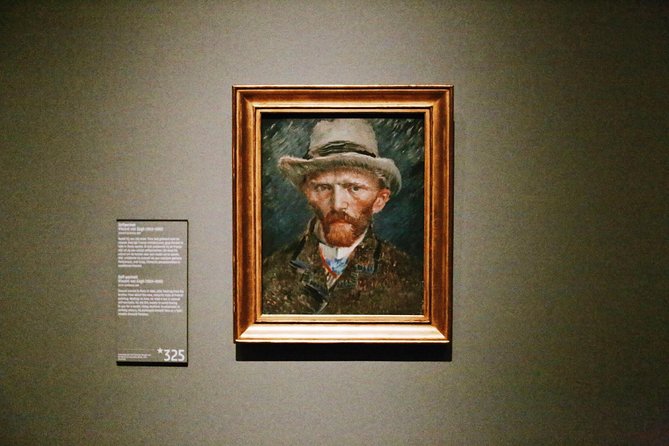
Next up: a walk alongside the Amstel River with views of two bridges you’ll hear about right away.
You’ll see:
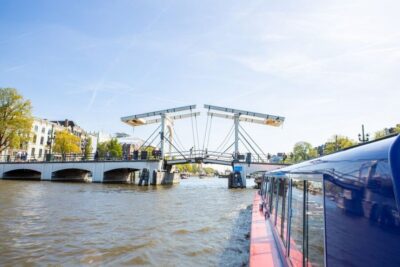
- the Skinny Bridge (spanning the Amstel from 1934, and described as Amsterdam’s most famous bridge)
- the Blue Bridge, which is not blue at all today, named after a 17th-century wooden blue bridge
These are quick glimpses, but they’re memorable because the names are so specific. A guide makes the difference between spotting a bridge and understanding why people talk about that bridge at all.
Stopera: city hall meets opera and ballet
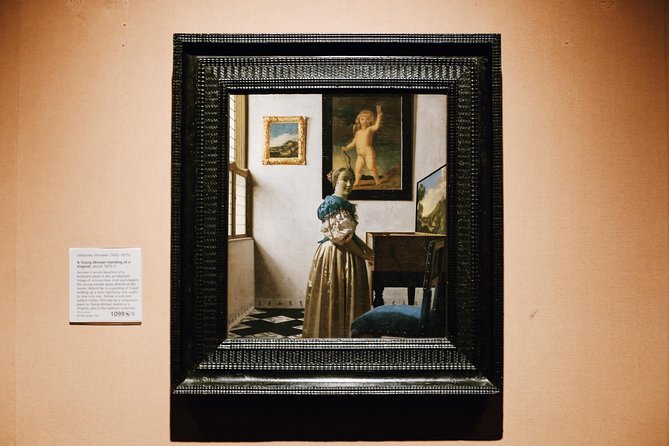
You’ll also pass by the Dutch National Opera & Ballet, housed in the complex known as the Stopera. The tour notes that construction took at least 60 years.
This stop is short, but it helps you understand Amsterdam as a place where grand cultural institutions and civic buildings sit close together. If you only picture museums and canals, this adds a missing piece.
Admission isn’t included here, so think of it as an architectural and cultural “look-and-learn” moment rather than an attraction you enter.
Jodenbuurt and the Rembrandt House finish
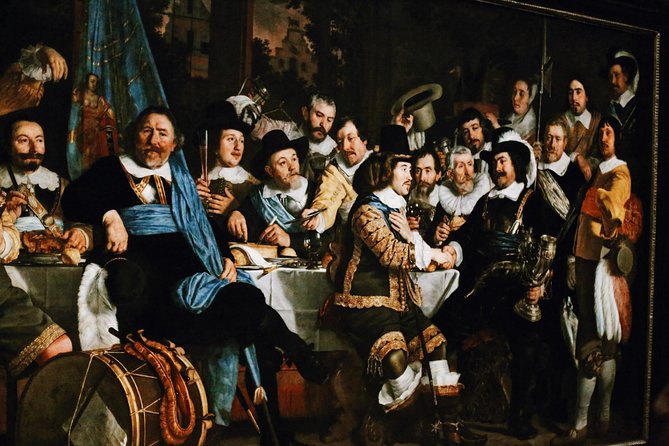
As you approach the final segment, you’ll walk toward Jodenbuurt, the former Jewish neighborhood, with many historically important buildings preserved and managed by the Jewish Cultural Quarter.
This is also where timing helps. You’re not done with the day yet, but you’re ready to shift from landmark facts into people stories. And that sets you up well for what comes next.
Museum Het Rembrandthuis: where Rembrandt lived and worked
The tour ends at Museum Het Rembrandthuis, where Rembrandt lived and worked between 1639 and 1656. The museum’s collection includes Rembrandt’s etchings and paintings of his contemporaries.
This is a different feeling from the Rijksmuseum. The Rijksmuseum is about Dutch art on a grand, curated scale. Rembrandt House is about the artist as a working person, surrounded by the traces of his life.
If you’re the type who loves seeing where creativity happens, you’ll appreciate this ending. It also gives your eyes a rest from the biggest gallery rooms, because the environment is more intimate by nature.
What’s included, what you pay for, and why the price makes sense
At $284.15 per person for roughly 5.5 hours, this isn’t a budget add-on. So the real question is value.
Here’s where the tour earns its keep:
- You get a guided museum experience at the Rijksmuseum with admission included and skip-the-line access.
- You also get guided entry to Rembrandt House Museum with admission included.
- There’s a private tour guide for your group (the information notes that if you choose a semi-private option, guide exclusivity does not apply).
- Entrance fees are covered, plus the walking portion that connects the museums to the city streets.
- It runs rain or shine, which matters in Amsterdam where weather can change its mind fast.
- There’s time built in for a lunch break, so the day doesn’t feel like a sprint.
What’s not included: Museum Van Loon and some other stops you’ll mainly see from outside. The tour includes multiple free walking viewpoints and canal areas. You don’t have to pay extra just to enjoy the city portion.
Also: gratuities are not included. That’s common, but it does mean you should plan for it if you feel the guide earned it.
Weather, closures, and museum rules you should not ignore
Amsterdam is good at surprising you, and the Rijksmuseum is no exception. The tour notes that Rijksmuseum may have occasional closures without prior warning. If that happens and the museum opening is delayed more than 1 hour from the tour start time, you’ll be offered an alternative. In those cases, refunds or discounts are not provided.
Plan for that possibility, but don’t panic. A good operator builds a workable backup when delays go over a threshold.
Beyond that, remember the museum security reality: bring a small bag. The tour explicitly says no large bags or suitcases are allowed inside the museum, only handbags or small thin bag packs. If you show up with the wrong size bag, you will lose time and maybe your mood.
Who this tour suits best
This is a strong fit if:
- you want Rijksmuseum highlights without spending half the day figuring out where to go
- you’re curious about Rembrandt beyond the paintings, including the setting of his home
- you like mixing art with a short guided walk through recognizable Amsterdam canals and squares
- you prefer a private, guided approach so your questions get answered on the move
It’s less ideal if you hate walking and standing. The tour asks for a moderate physical fitness level, and the route includes multiple stops and transfers on foot.
Should you book this Rijksmuseum and Rembrandt House tour?
Book it if you want a guided day that turns Amsterdam art into a storyline. The skip-the-line access plus the structured focus in the Rijksmuseum are the big reasons. You get the famous paintings, but you also get the cultural details that make the museum feel understandable instead of overwhelming.
Don’t book it if you’re planning to spend the day with maximum freedom, because this is a guided route with set timing and museum rules. Also, bring a small bag and dress appropriately, or you’ll feel the friction quickly.
If your goal is a smart, time-saving half-day that ends with Rembrandt House instead of another generic museum loop, this is the kind of plan that works.
Loops Taking In the Big Sights
- Amsterdam: 75 Minute City Canal Cruise with Audio Guide
★ 4.4 · 19,938 reviews - Amsterdam: City Centre Canal Cruise including Audioguide
★ 4.3 · 16,901 reviews - Amsterdam: Smoke and Lounge City Boat Cruise
★ 4.7 · 8,572 reviews - Amsterdam: City Card with Free Entrance & Public Transport
★ 4.3 · 4,145 reviews
Newest on the canal ring
- Amsterdam Bike Food Tour with Private Guide★ 5.0 · 1 review
- Amsterdam: Rijksmuseum Private Tour with an Art Historian★ 5.0 · 1 review
- Happy B-day Amsterdam! Guided Tour with a History Buff★ 5.0 · 1 review
- Local Foodie Adventure in Amsterdam★ 5.0 · 1 review
- Private Photo Shoot in Amsterdam with a Professional Photographer★ 5.0 · 1 review
- Private day trip to Giethoorn and the Enclosing Dike★ 5.0 · 1 review
- Private Sightseeing Tour to Giethoorn from Amsterdam incl. canal cruise★ 5.0 · 1 review
Rijksmuseum Tickets, compared.

Rijksmuseum Amsterdam Small-Group Tour with Private Upgrade
Read our review →
Rijksmuseum Entry Ticket and Canal Cruise Combo
Read our review →
Go City Amsterdam Pass: Attractions Pass with Rijksmuseum
Read our review →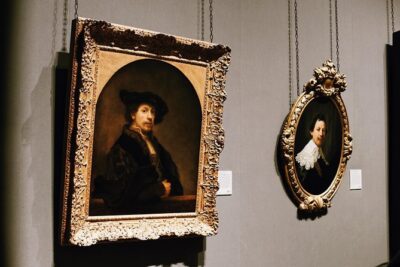
Rijksmuseum Amsterdam Exclusive Guided Tour w/ Reserved Entry
Read our review →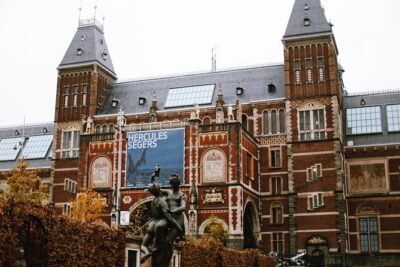
Van Gogh & Rijksmuseum w/ Reserved Entry Semi-Private 8ppl Max
Read our review →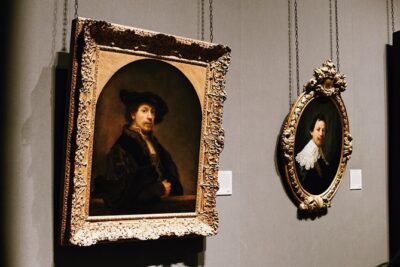
Van Gogh & Rijksmuseum w/ Reserved Entry Exclusive Guided Tour
Read our review →Browse the lists this tour appears in