

Reviewed · SIGHTSEEING TOURS
Amsterdam: Private Pedicab Historical Sightseeing Tour
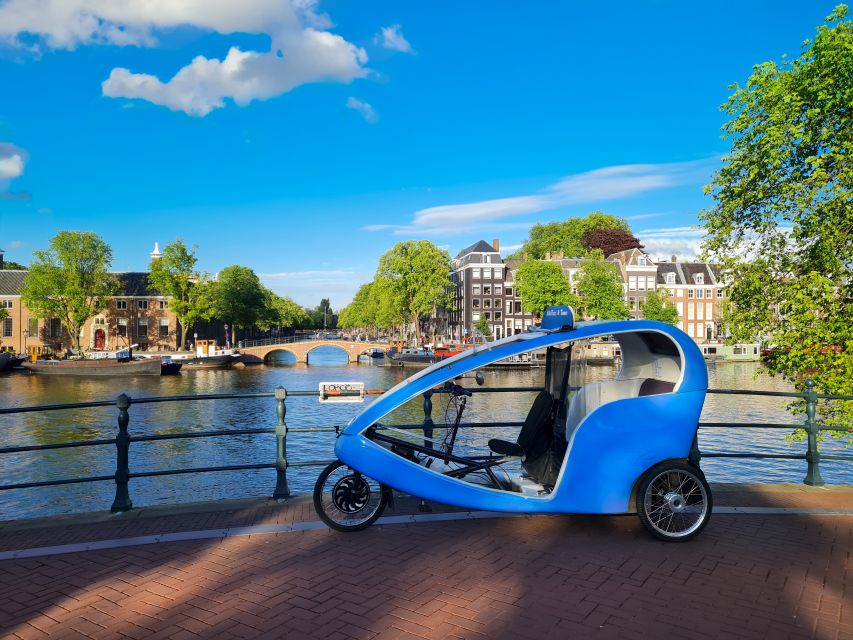
Two hours, and Amsterdam feels like your neighbor. I love the private pedicab setup, which keeps walking low while still getting you through classic streets and canal-side views. I also like the way your guide, Bram, ties each stop to what was happening in the city back then. One caution: with only 2 hours, the tour is a fast highlight loop, so you may want more time if you’re hoping for long museum wandering.
You’ll start at Dam Square and glide through the old center, the 17th-century canal district, the Jewish Quarter, a peek toward Chinatown, and then end around Museumsquare. Pickup and drop-off are included, and there’s a blanket for cooler weather. The guide speaks English, Dutch, and German, which helps if you prefer history explained in plain, local terms rather than secondhand guidebook summaries.
In This Review
- Key reasons this pedicab tour earns 5-star praise
- Why Amsterdam works best on a pedicab
- Dam Square to the Royal Heart of the Old Centre
- Zeedijk and Nieuwmarkt: dikes, a classic interior, and a 15th-century city gate
- Montelbaanstoren and the view over the Oude Waal
- Jewish Quarter essentials: Big Synagogue, Portuguese Synagogue, and 102,000 names
- Hermitage at a former widow house, then the Skinny Bridge lights
- The 17th-century canal district ring: what you’re really seeing in the canal houses
- Museumsquare and the Rijksmuseum tunnel stop
- Comfort, timing, and the real value of the price
- Who should book this pedicab tour (and who might want a different option)
- Practical notes to keep your day smooth
- Should you book this Amsterdam pedicab historical tour?
- FAQ
- Where does the tour start and how do I get picked up?
- How long is the Amsterdam pedicab tour?
- What languages are available for the live guide?
- Is the tour private?
- What should I bring for the ride?
- What are the weight limits?
Key reasons this pedicab tour earns 5-star praise
- Dam Square to Museumsquare pacing that covers multiple neighborhoods without feeling like a sprint
- Bram’s explanations with photos and maps, so you can actually picture how Amsterdam changed over time
- Comfort in cold or rainy weather, including a blanket, plus warm, practical guidance
- Pedicab access to streets cars cannot reach, which makes the route feel more personal and less tour-bus generic
- Photo-friendly viewpoints, including the Amstel river panorama and iconic bridge moments
- Flexible finishing point, since you can set your preferred end location ahead of time
Why Amsterdam works best on a pedicab
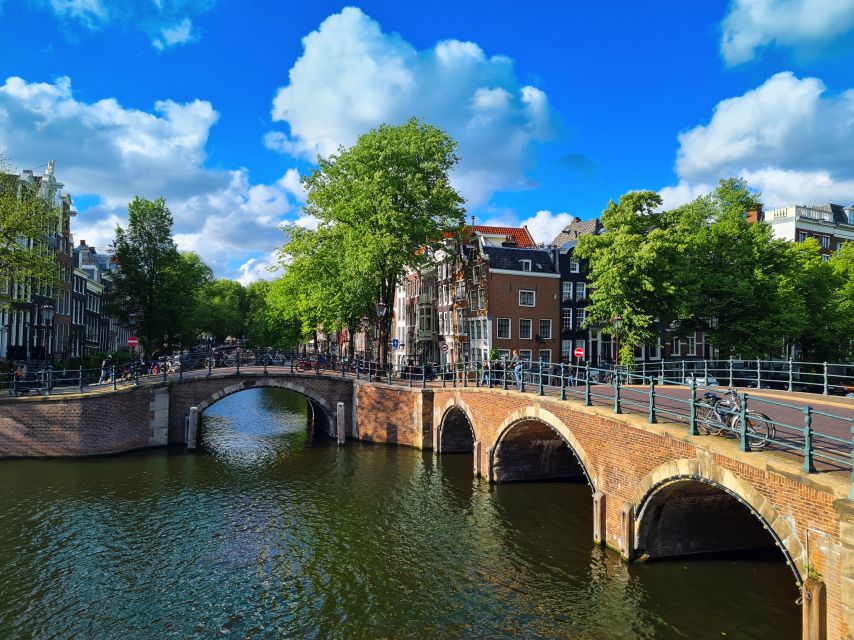
Amsterdam’s best neighborhoods are tight, twisty, and full of canal-side corners where walking can start to feel like a chore. A private pedicab solves that. You get the street-level feel of Amsterdam without spending the whole day on your feet, and you can still pause when you want a better angle of the canals.
This tour is also built for a small group, so you are not squeezed into a big, noisy pack. In the reviews, people specifically called out how helpful the format was when walking ability was limited. You still need to be comfortable getting in and out for stops, but the ride between them is the main point.
Other loops taking in the big sights:
- Amsterdam: 75 Minute City Canal Cruise with Audio Guide
★ 4.4 · 19,938 reviews - Amsterdam: City Centre Canal Cruise including Audioguide
★ 4.3 · 16,901 reviews - Amsterdam: Smoke and Lounge City Boat Cruise
★ 4.7 · 8,572 reviews
Dam Square to the Royal Heart of the Old Centre
You begin at Dam Square, the birthplace core of Amsterdam. This is where the city started growing, and it’s still the kind of place where you can instantly understand why power, commerce, and public life clustered together.
At Dam Square you’ll see the Royal Palace, the New Church, and the National Monument. The practical value here is that these landmarks give you a map in your head before you move on to the canal districts. Instead of hopping randomly, you’re building a story: city growth, royal presence, and how Amsterdam became the kind of place that needed monuments in the first place.
Zeedijk and Nieuwmarkt: dikes, a classic interior, and a 15th-century city gate
After Dam Square, your route turns toward Zeedijk. This street has a past that is more functional than pretty: it used to be part of the dike system that protected the older city. That context matters because Amsterdam’s canals and neighborhoods were not just built for views. They were built to manage water, land, and survival.
On Zeedijk you’ll also spot the oldest cafe still standing, with its original interior. Even if you do not stop for a drink, seeing places that have kept their feel for centuries gives you a quick reality check. Amsterdam did not reinvent itself every decade. Lots of its identity has stayed in place.
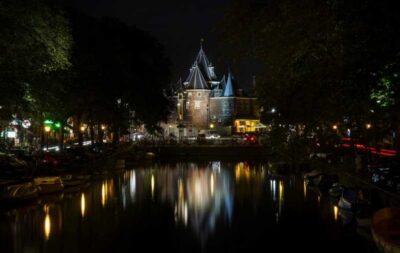
Then you’ll move toward Nieuwmarkt. This area’s centerpiece is the 15th-century city gate, positioned in the middle of the square. Your guide explains why a city gate is a big deal: it marks where movement, control, and city boundaries used to be, long before modern maps turned everything into one continuous grid.
There’s also a nearby Chinatown glimpse built into this part of the ride. That matters for first-time visitors because it’s not just “one famous neighborhood.” You’re learning how Amsterdam mixes eras and cultures in the same walking distance.
Montelbaanstoren and the view over the Oude Waal
Next comes a stop at the Montelbaanstoren, an old watch and defense tower. It belongs to Amsterdam’s expanded defense line from the early 1500s, when keeping an eye on the water and approaches was survival, not history trivia.
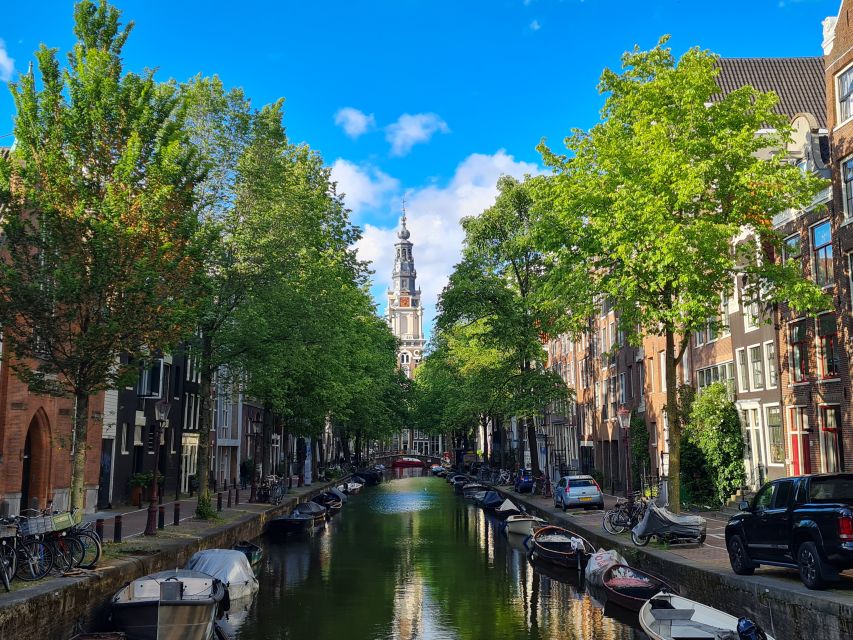
From here you get a good lookout over the Oude Waal, with houseboats lined up and classic canal houses forming the background. This is a rare mix of city function and city beauty. You’re looking at how people lived near the water while the city expanded its defenses and trade networks.
If you like photography, this is one of the moments you’ll appreciate later. It’s the kind of view where you can take a few frames and understand the city’s layout at the same time.
More of the Golden Age still standing:



Jewish Quarter essentials: Big Synagogue, Portuguese Synagogue, and 102,000 names
The Jewish Quarter is one of the most important parts of the route, and your guide gives it careful context. You’ll see the very first synagogue that Jewish people were allowed to build in Western Europe over 350 years ago, often referred to as the Big Synagogue. You’ll also see the Portuguese Synagogue across the way.
This section does not feel like a checklist. It’s more like a guided lesson in how communities arrived, gained legal space, and built institutions that shaped Amsterdam’s cultural and commercial life.
You’ll also visit the Holocaust name monument, made with 102 thousand bricks, each giving the names of Dutch Jewish victims of the Second World War. That number is heavy. But the value of the stop is clarity, not shock: you come away understanding that this neighborhood carries modern meaning, not only old architecture.
Right opposite the monument, your route passes a row of 17th-century canal houses linked to Sephardic Jewish immigrants who were successful in the diamond business. That detail helps you see the neighborhood as lived history, not just memorials and buildings.
Hermitage at a former widow house, then the Skinny Bridge lights
As the tour continues, you’ll make your way to the Hermitage, housed in a large old 17th-century widowhouse. This kind of building matters because it hints at how wealth, family structure, and property worked in Amsterdam long before modern museums.
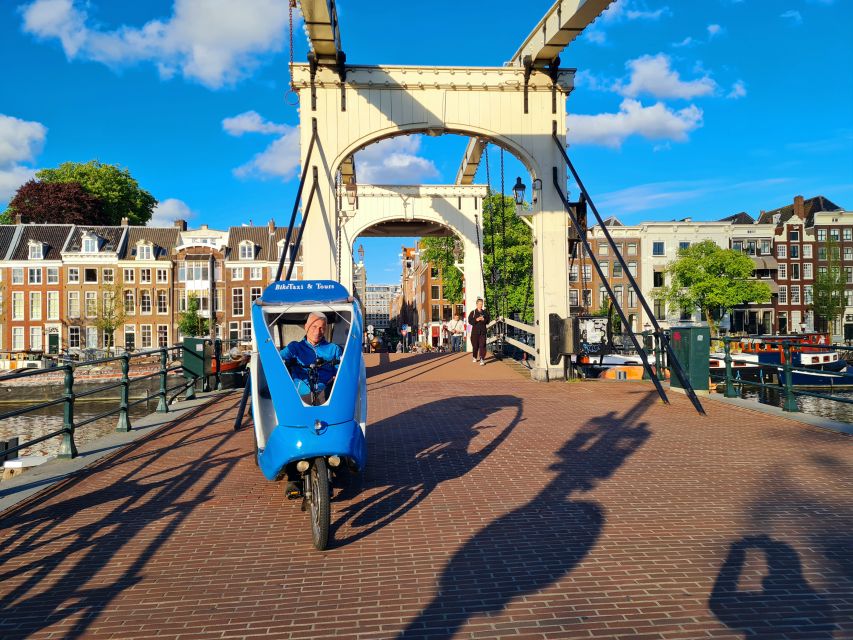
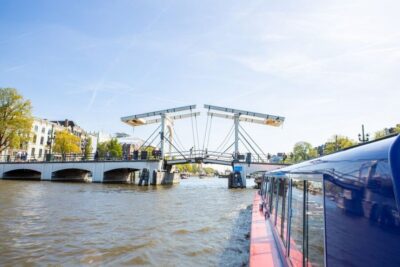
Then you head to one of Amsterdam’s most iconic photo spots: the Skinny Bridge. Even during daytime, it’s visually distinctive, and at night it lights up with hundreds of bulbs accenting its slender design. If you’re traveling at the right time of day, it becomes an easy, recognizable “I’m really in Amsterdam” moment.
From the bridge area you’ll also have a panoramic view over the Amstel River, Amsterdam’s main and widest canal. This is a strong spot for pictures, but it’s also a good place to pause and look around. The canal ring only makes sense once you see how the water threads through everything.
The 17th-century canal district ring: what you’re really seeing in the canal houses
After the river views, the ride continues through the 17th-century canal district around the old center. On a city map, the district shows up like half circles wrapping the center. That simple geometry explains a lot about why Amsterdam’s center looks the way it does.
Your guide points out the canal houses that were once homes of successful merchants. A helpful detail is that the houses are not cookie-cutter copies. On the surface, they share common features typical of the era, but each one has variations. Those differences can hint at when and how each building was shaped.
This is where the tour earns its keep for people who like to understand patterns. Instead of only admiring facades, you learn how the city’s wealth and trade shaped architecture.
Museumsquare and the Rijksmuseum tunnel stop
You finish near Museumsquare, a large 19th-century green open square. It’s known as home to the Netherlands’ most important museums, including the Rijksmuseum and the Van Gogh Museum.
A neat touch is that you’ll drive through the Rijksmuseum tunnel and then stop in the middle of the square. That route gives you a perspective you do not get from walking a normal museum block. You see how these cultural landmarks sit within the wider city fabric, not just as isolated stops.
Before you book, think about how you want the day to end. The tour lets you set a desired finish location in advance, which is handy if you want to connect to dinner plans or reach a nearby hotel without extra hassle.
Comfort, timing, and the real value of the price
The price is $230 per group up to 2 for 2 hours, with hotel pickup and drop-off included. If you split it with a partner, that can work out to a reasonable cost per person for a private guide and a route that hits multiple neighborhoods in one go.
For solo travelers, it’s still potentially good value if you care about the guide component. This isn’t just “ride around town.” You’re paying for guided interpretation at several key historical zones, plus the ability to keep mobility lower than you would with long walking routes.
Timing is the main trade-off. Two hours is enough to cover a highlight circuit, but it’s not enough for long stops inside museums. If you’re museum-first, you might be happier adding time before or after the pedicab. The reviews also mention that extending to 3 hours was possible, which suggests the guide can slow down if you want more breathing room.
Who should book this pedicab tour (and who might want a different option)
This tour is a strong match if you:
- Want a first-time Amsterdam orientation with a local, who can explain why places matter
- Prefer private pacing over big-group tours
- Have limited walking ability but still want to see the canal-ring neighborhoods and key memorial sites
- Like your history tied to specific streets and buildings, not just broad timelines
It may be less ideal if:
- You want lengthy museum time during the tour itself
- You expect to stop frequently for long photo sessions at every landmark
- You do not meet the weight limits, since safety rules apply
Practical notes to keep your day smooth
Bring warm clothing. A blanket is included for cold weather, and multiple reviews mention that it helped on rainy or chilly days, but you will still feel better if you dress for wind and weather.
Also pay attention to the weight limits: the maximum combined passenger weight is 200 kg, and it is not suitable for people over 220 lbs (100 kg). If you’re traveling with anyone who might be near that limit, double-check before you go.
You won’t get food or drinks included, so plan water or a light snack around the ride. The tour is focused on sightseeing and explanation, not breaks for meals.
Should you book this Amsterdam pedicab historical tour?
If you want a smart way to cover Dam Square, the Jewish Quarter, the canal district, and the museum area without wearing out your legs, I’d book it. The big reason is the guide approach, Bram, with clear explanation and visual aids like photos and maps, plus the comfort factor of a blanket and a private ride that gets you close to the action.
Book this especially if you like history that connects streets to events and everyday life. And if you think 2 hours might feel short, consider planning your day so you can extend or add time elsewhere after the tour.
FAQ
Where does the tour start and how do I get picked up?
The tour starts at Dam Square. Pickup from your hotel and drop-off are included, and you should wait outside in front of your hotel.
How long is the Amsterdam pedicab tour?
It lasts 2 hours.
What languages are available for the live guide?
The live guide is available in English, Dutch, and German.
Is the tour private?
Yes, it is a private group.
What should I bring for the ride?
Bring warm clothing. A blanket is provided in case of cold weather.
What are the weight limits?
The maximum combined passenger weight is 200 kg. The tour is not suitable for people over 220 lbs (100 kg).
Newest on the canal ring
- Amsterdam Bike Food Tour with Private Guide★ 5.0 · 1 review
- Amsterdam: Rijksmuseum Private Tour with an Art Historian★ 5.0 · 1 review
- Happy B-day Amsterdam! Guided Tour with a History Buff★ 5.0 · 1 review
- Local Foodie Adventure in Amsterdam★ 5.0 · 1 review
- Private Photo Shoot in Amsterdam with a Professional Photographer★ 5.0 · 1 review
- Private day trip to Giethoorn and the Enclosing Dike★ 5.0 · 1 review
- Private Sightseeing Tour to Giethoorn from Amsterdam incl. canal cruise★ 5.0 · 1 review
Sightseeing Tours, compared.
75 Minute City Canal Cruise with Audio Guide
Read our review →
City Centre Canal Cruise including Audioguide
Read our review →
City Card with Free Entrance & Public Transport
Read our review →
Browse the lists this tour appears in